Marketplace or your own store? A decision checklist for retailers
The question that gets asked too late
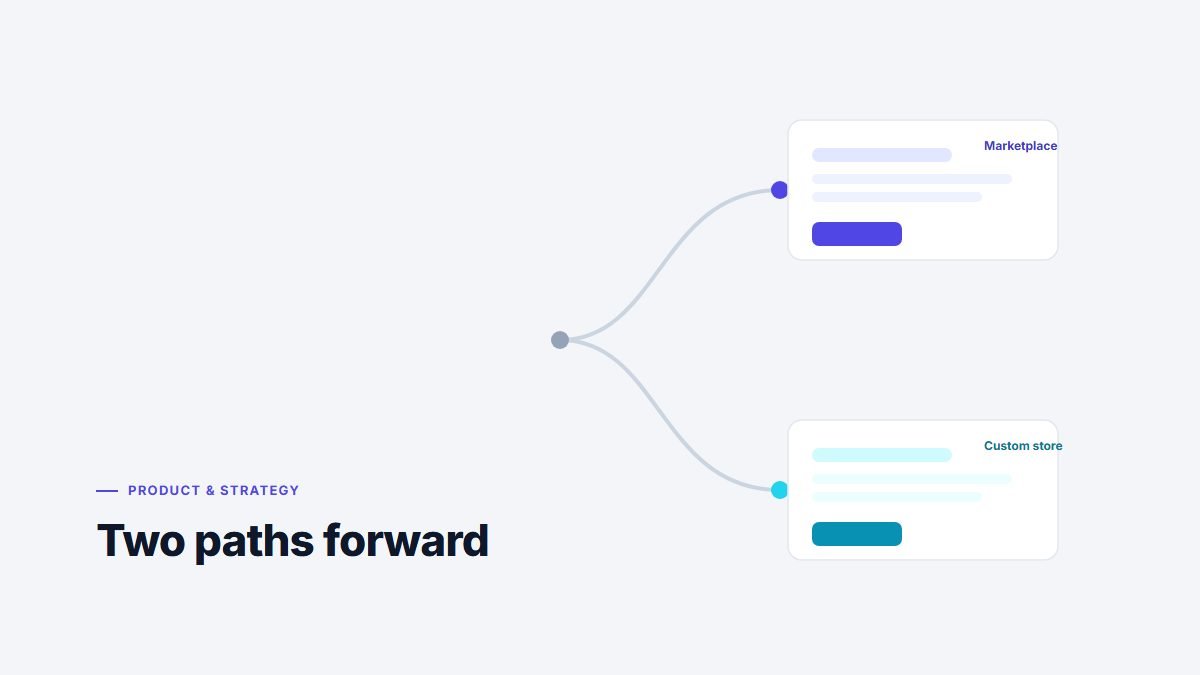
We hear this question most often after a retailer has already signed up for a marketplace, spent a year building a catalogue and a following, and then found that fees, data ownership terms or the lack of control over the customer relationship have started working against them. Marketplace versus custom store is not a permanent choice. It is a sequencing decision, and getting the sequence right saves a rebuild later.
What a marketplace actually buys you
A marketplace gives you existing search traffic, a payment and logistics stack you do not have to build, and a trust signal a brand new domain does not have on day one. For a retailer testing a new product category or entering a new country, that is often worth the commission. The cost is real too: you do not own the customer record, you cannot run your own promotions, and your price sits next to every competitor selling the same item.
What a custom store actually costs
A custom store means owning checkout, SEO, customer data and the full margin on every sale. It also means owning customer acquisition from zero, plus the operational load of payments, tax and fraud that a marketplace used to carry for you. We build custom stores integrated with the retailer's existing inventory and accounting system, not as a separate island, on a Symfony commerce stack with PostgreSQL behind it. Most of the real project time goes into that integration, not the storefront itself.
The cost of running both channels
Retailers running both a marketplace listing and a custom store usually underestimate the work of keeping them in sync. Stock, price and product descriptions have to match across channels, or the marketplace still shows an item in stock after your own store sold the last unit, and an order arrives you cannot fulfil. We build this as a single source of truth for inventory that both channels read from and write to, through the marketplace's own feed API where one exists, instead of maintaining stock counts by hand in two places. Retailers who skip this step usually find out the hard way, with an overselling incident on a busy weekend.
The checklist we actually use
- Do you already have a customer list, an email base or a physical store you can send traffic to without paying for it? If yes, a custom store works earlier than you might think.
- Is your product a commodity or is it differentiated? Commodity products live or die on marketplace visibility. Differentiated products with brand value get diluted by marketplace price comparison.
- Can your operations handle direct fulfilment, returns and customer service without the safety net a marketplace provides? If not, that gap needs a plan before launch, not after.
- Do you need customer data beyond this one sale? Repeat purchase businesses need the relationship a marketplace will not give you.
- How does your margin after marketplace commission compare with your margin after the cost of running your own store, traffic included?
The sequence that works for most retailers
The retailers we have seen make the best call actually run both, deliberately, at different stages. A marketplace presence tests demand and product-market fit at low fixed cost. Once a product line proves itself and repeat customers start showing intent to buy directly, a custom store recovers the relationship and the margin the marketplace was taking. Running both at once, instead of switching from one to the other, also protects the business from a marketplace policy change turning into an existential risk.
Our recommendation for a retailer asking this question today: keep the marketplace channel for discovery and testing. Build the custom store as soon as you have a repeat-purchase signal worth owning, integrated with the systems you already run the business on, not as a separate silo.